Why is my refrigerator leaking water onto the kitchen floor
A puddle under your fridge is almost never the fridge itself. Here are the seven real causes, what each one costs to fix in 2026, and when it becomes water damage.
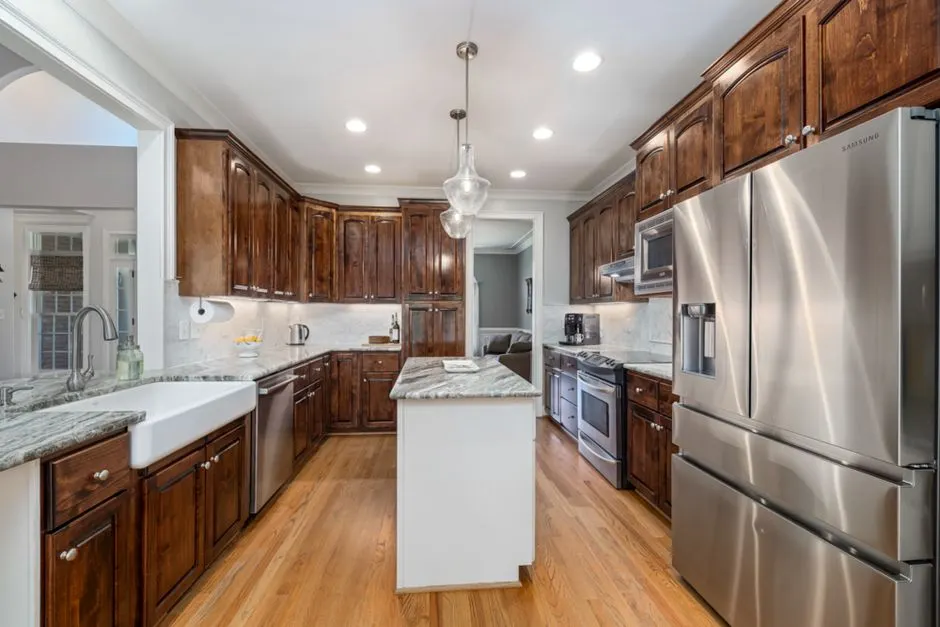
Your refrigerator is leaking water because the water line, drain pan, or defrost system has failed - not because the fridge is "broken." In nine out of ten kitchens we walk into, the puddle traces back to a cracked saddle valve on the copper supply line, a clogged defrost drain tube, or a drain pan that has cracked after 12 to 15 years of thermal cycling. The fridge still cools perfectly. It just quietly empties a cup of water onto your floor every few hours.
We are going to walk through the seven causes in order of how often we see them in Gaithersburg, what each one costs to fix in 2026, how to trace the leak yourself in 15 minutes, and the point at which a slow drip turns into a flooring and subfloor problem you cannot mop away.
The short answer: it is almost never the fridge
A refrigerator leaking water on the floor in Gaithersburg is a plumbing or drainage symptom, not a refrigeration failure. The compressor, the refrigerant loop, and the thermostat are almost always fine. What has failed is one of the parts that moves water: the supply line feeding the ice maker and water dispenser, the condensate drain that carries defrost water to the pan, or the pan itself.
That distinction matters because it changes who you call and what you pay. A refrigeration technician charges $150 to $300 just to diagnose a sealed-system problem. A water line or drain tube fix is a $95 to $250 job, and often less if the part is a $12 saddle valve or a $20 drain clip.
Here is the definitional version, in case you are searching this at 11 p.m. with a towel under the fridge: a refrigerator water leak is a failure in the appliance's water delivery or condensate drainage system that releases standing water onto the kitchen floor, and it needs to be stopped and dried within 24 to 48 hours to prevent subfloor and cabinet damage.
Why is my refrigerator leaking water onto the floor in Gaithersburg MD?
Gaithersburg homes leak for seven specific reasons, and the age of your house usually predicts which one you are dealing with. A 1980s split-level off Quince Orchard Road has different failure points than a 2018 townhouse in the Watkins Mill corridor.
1. A cracked or loose water supply line
This is the number one cause we find. The 1/4-inch copper or braided line that feeds your ice maker runs from a saddle valve on a cold-water pipe, usually under the kitchen sink or in the basement ceiling. Saddle valves pierce the pipe with a needle and seal with a rubber gasket. That gasket hardens. After 10 to 15 years it weeps, then drips, then sprays.
Braided stainless lines fail differently - the crimp ferrule loosens and the line seeps at the connection point. Either way, you get water on the floor behind the fridge, and it usually shows up first as a dark stain on the back of the drywall or a warped section of laminate.
2. A clogged or frozen defrost drain tube
Every frost-free fridge runs a defrost cycle two to four times a day. Melted frost drains through a tube at the back of the freezer compartment down to the drain pan. That tube is roughly 3/8 inch wide. It clogs with food particles, ice, and mold biofilm.
When it clogs, water backs up and either pools inside the freezer floor or overflows down the back of the unit onto your kitchen floor. If your leak only happens after the fridge has been running a while, and the water appears at the back rather than the front, this is your culprit. A $6 pipe brush and 10 minutes usually clears it.
3. A cracked or misaligned drain pan
The drain pan sits at the bottom of the fridge, under the compressor. It catches defrost water and lets it evaporate. Pans crack from thermal stress, and they shift out of position when the fridge is rolled out for cleaning. A pan that has slid two inches to the left dumps every drop onto the floor instead of into the pan.
Replacement pans run $25 to $60 depending on the model. On older Gaithersburg rentals, we sometimes find the pan missing entirely - a previous tenant or handyman removed it and never put it back.
4. A failing water inlet valve
The inlet valve is the solenoid that opens to fill your ice maker and dispenser. It sits at the back of the fridge where the supply line connects. The internal diaphragm wears out, and the valve drips continuously - not just when the ice maker calls for water.
You can test this in two minutes. Pull the fridge out, dry the valve body completely, and watch it for 20 minutes with the ice maker turned off. If it is wet again, the valve is passing. Replacement valves are $40 to $90, and labor is typically $120 to $180.
5. A blocked or kinked ice maker fill tube
The fill tube carries water from the inlet valve into the ice maker mold. If it freezes, kinks, or gets pushed out of alignment during a freezer reorganization, water sprays into the freezer and then runs out the door seal onto the floor.
Look for ice buildup around the fill tube entry point on the back wall of the freezer. That is the tell.
6. A worn door gasket letting warm air in
A gasket that no longer seals lets humid Gaithersburg summer air into the fridge. That moisture condenses, freezes, and then melts during defrost - producing more defrost water than the drain system was designed to handle. The excess ends up on your floor.
Test it with the dollar-bill trick: close the door on a dollar bill at several points around the perimeter. If it slides out with no resistance, the gasket is done. New gaskets are $40 to $120 and are a 30-minute job on most models.
7. A clogged or disconnected water filter housing
If your fridge has an in-door or in-grille water filter, the housing O-ring can fail or the housing can crack. This produces a steady drip whenever the dispenser is used, and sometimes a slow weep even when it is not. Twist the filter out and inspect the O-ring for flattening or nicks.
We handle the cleanup side of these calls constantly across the region, including Water Damage Restoration in North Potomac, where the 1990s construction means a lot of original saddle valves are now past their service life.
How to trace the leak in 15 minutes
Tracing a refrigerator water leak takes 15 minutes and one roll of paper towels. Work from the outside in, and dry every surface completely between steps so you can see where new water appears.
- Dry the floor and the fridge base completely. Lay paper towels under the front and back edges. Wait 30 minutes.
- Check which end is wet. Water at the back points to the supply line, inlet valve, or drain tube. Water at the front points to the door gasket or a fill tube spraying inside the freezer.
- Pull the fridge out and inspect the supply line. Look for corrosion at the saddle valve, green or white crust on copper, or damp braided mesh.
- Look at the drain pan. Is it cracked, full, or shifted off-center? Is it there at all?
- Open the freezer and check the back wall. Ice around the fill tube or a frozen sheet on the freezer floor means a defrost drain problem.
- Run the water dispenser for 30 seconds. Watch the inlet valve and filter housing while it runs. Any drip is your answer.
If you get through all six steps and the floor is still dry, the leak is intermittent - most likely the defrost cycle. Leave the paper towels down overnight and check them in the morning.
How do I stop my fridge from leaking water in Gaithersburg?
You stop the leak by fixing the specific failed part, not by turning the ice maker off and hoping. Shutting off the ice maker stops supply-line leaks but does nothing for a clogged defrost drain, and that is the one that quietly rots your subfloor.
Here is the fix for each cause, in order of difficulty:
- Supply line: Shut off the saddle valve, disconnect both ends, and replace the line with a braided stainless kit ($15 to $30). If the saddle valve itself is corroded, replace it with a proper quarter-turn shutoff valve - this is a plumber's job and runs $150 to $300.
- Defrost drain tube: Unplug the fridge, remove the back panel inside the freezer, and flush the tube with warm water. A pipe brush clears stubborn clogs. Reassemble and test through one full defrost cycle.
- Drain pan: Order the pan by model number, slide the old one out, and seat the new one centered under the drain outlet.
- Inlet valve: Shut off water, unplug the fridge, disconnect the harness and both water lines, and swap the valve. Reconnect and check every joint with a dry paper towel.
- Door gasket: Order by model number, peel the old gasket out of its channel, and press the new one in. Warm it with a hair dryer on low to seat the corners.
If you are not comfortable with the supply line or the inlet valve, that is the right instinct. Water and 120-volt appliance wiring do not mix, and a cross-threaded compression fitting will fail at 2 a.m. on a Sunday.
What it costs to fix a refrigerator water leak in 2026
Typical 2026 pricing in the Gaithersburg area runs $95 to $250 for a refrigerator water leak repair, with the average call landing around $165. That covers diagnosis plus the most common fixes: drain tube clearing, drain pan replacement, and supply line replacement.
Here is how the numbers break down by job:
- Drain tube clearing: $95 to $150
- Drain pan replacement: $120 to $200 including the part
- Supply line replacement: $130 to $220
- Inlet valve replacement: $160 to $270
- Door gasket replacement: $150 to $260
- Saddle valve upgrade to a quarter-turn shutoff: $150 to $300
Compare that to a new refrigerator. A comparable French-door model runs $1,400 to $2,600 in 2026, plus $75 to $150 for haul-away and installation. If your fridge is under 12 years old and the compressor is healthy, repair is the obvious call.
If the leak has been running for weeks, add drying and repair costs on top. That is a separate number, and we will get to it in the next section.
Can a refrigerator leak cause water damage in Gaithersburg Maryland?
Yes - and a slow refrigerator leak causes more damage than a fast one, because nobody notices it for weeks. A supply line that sprays 2 gallons a minute gets caught in an hour. A drain pan that overflows a cup a day soaks into the same 4 square feet of subfloor for a month before the laminate starts to cup.
What we find when we open up a kitchen after a long-running fridge leak:
- Warped or cupped laminate and engineered hardwood within 48 to 72 hours of continuous moisture
- Swollen particleboard cabinet toe kicks and, in bad cases, the cabinet base itself
- Soft or crumbling subfloor - plywood delaminates and OSB turns to mush after 2 to 3 weeks of saturation
- Mold colonization starting at 24 to 48 hours in the dark, humid space behind the fridge
- Stained or bubbling drywall on the wall the fridge backs up to, and on the ceiling of the floor below in second-floor kitchens
Gaithersburg makes this worse in two specific ways. First, a large share of the housing stock here was built between 1975 and 1995, which means original saddle valves and original subfloor plywood are both at end of life. Second, our summers run humid enough that a wet cavity behind a fridge does not dry on its own - it stays at 70 percent relative humidity and feeds mold.
If the water has been running for more than a day, you are past the mop-and-fan stage. We handle Water Damage Repair in Gaithersburg for exactly this scenario - extracting standing water, drying the cavity with commercial dehumidifiers, and replacing subfloor that has gone soft.
Common mistakes we see homeowners make
The mistakes that turn a $150 repair into a $4,000 restoration are almost always about timing, not skill. Here are the ones we see most often.
- Turning off the ice maker and calling it fixed. That stops supply-line water but leaves the defrost drain overflowing. The floor stays wet.
- Mopping and moving on. A mop removes surface water. It does nothing for the water that has already wicked into the subfloor and the cabinet base.
- Running a box fan for an hour. A household fan moves air. It does not lower the moisture content of saturated plywood. You need a refrigerant dehumidifier and 3 to 5 days.
- Ignoring the smell. A musty odor behind the fridge is mold, not stale food. By the time you can smell it, colonization is well underway.
- Pushing the fridge back against the wall. Fridges need 1 to 2 inches of clearance at the back for the condenser to breathe. Tight against the wall, the unit runs hotter, defrosts more, and leaks more.
- Not shutting off the water before pulling the line. We get at least one call a month from someone who disconnected a live supply line and flooded their kitchen in 30 seconds.
We also see this pattern in the older townhome clusters around Water Damage Restoration in Montgomery Village, where stacked units mean a second-floor fridge leak shows up as a ceiling stain in the unit below before the owner upstairs notices anything.
When to call a professional
Call a professional the moment water has been sitting for more than 24 hours, or the moment you can see or smell damage beyond the floor surface. Those are the two lines that separate a repair from a restoration.
Specifically, call us if:
- The water has been leaking for more than a day, or you do not know how long it has been leaking
- The flooring is cupped, buckling, or spongy underfoot
- There is a musty smell in the kitchen or the room below
- You see staining or bubbling on the wall behind the fridge or on a ceiling below
- The cabinet base or toe kick is swollen
- You have already fixed the part and the floor is still wet
Our team finds the source, stops it, extracts the standing water, and dries the cavity with commercial equipment. We check moisture content in the subfloor and the cabinet base with a meter before we call it done - not by feel. If the subfloor has gone soft, we replace the damaged section rather than drying over it.
If the leak has spread into a commercial kitchen or a multi-unit building, we handle commercial water damage restoration in Gaithersburg with the same process at a larger scale, including after-hours drying so you do not lose a day of service.
Frequently Asked Questions
Why is my refrigerator leaking water onto the floor in Gaithersburg MD?
The most common cause is a cracked or loose water supply line at the saddle valve, followed by a clogged defrost drain tube and a cracked drain pan. In Gaithersburg's older housing stock, original saddle valves from the 1980s and 1990s are the single biggest culprit. A 15-minute trace will usually identify which one you have.
How do I stop my fridge from leaking water in Gaithersburg?
Shut off the water supply at the saddle valve first, then fix the specific failed part. Clear the defrost drain tube with warm water and a pipe brush, reseat or replace the drain pan, and replace any corroded supply line with a braided stainless kit. If the inlet valve drips with the ice maker off, replace it.
Can a refrigerator leak cause water damage in Gaithersburg Maryland?
Yes. A slow leak running for 2 to 3 weeks will delaminate plywood subfloor, swell cabinet bases, and start mold growth within 24 to 48 hours. Gaithersburg's humid summers mean a wet cavity behind the fridge will not dry on its own. Anything past 24 hours needs professional extraction and drying.
How much does refrigerator water leak repair cost in Gaithersburg?
Typical 2026 pricing runs $95 to $250, with the average call around $165. Drain tube clearing is the cheapest fix at $95 to $150. Inlet valve replacement is the most expensive common repair at $160 to $270. A saddle valve upgrade to a quarter-turn shutoff adds $150 to $300.
Will homeowners insurance cover water damage from a refrigerator leak?
Most standard policies cover sudden and accidental discharge, like a supply line that bursts. They typically exclude damage from a leak you knew about and did not address. Document the date you noticed it, photograph everything, and call your adjuster before you start repairs.
Get help with Water Damage Restoration in Gaithersburg
If your refrigerator has been leaking onto the kitchen floor and the damage has moved past the surface, we can stop it and dry it out before it reaches the subfloor. We serve Gaithersburg and the surrounding communities, and we will tell you honestly whether you need drying or just a repair.
Call Water Damage Restoration at 123456789 to schedule an inspection.